

Study Abroad is transformative
Students who study abroad often return home with a sense that they have had a transformative experience. Learning about the cultures and histories of other countries can serve as a gateway to understanding our own society. Students discover how people in other cultures in other times have treated those who are different — the other.
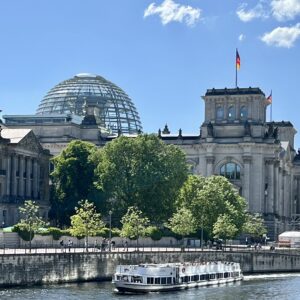
Berlin and Amsterdam are living classrooms for understanding how societies remember atrocities resulting from intolerance of otherness. Both cities were deeply scarred by Nazi rule and genocide. The transformative experience of memorials, museums, and everyday streetscapes preserve the past. They also serve as examples of how the legacy of otherness continues to shape our world today. These venues for a transformative study abroad experience reinforce empathy and connection in cross-cultural learning between Europe and the United States.
The ways in which Berlin and Amsterdam remember the Nazi period demonstrate two distinct approaches: Berlin’s state-supported confrontation and Amsterdam’s community-rooted recovery of erased lives. Berlin’s urban landscape is layered with visible and invisible traces of its past. The Memorial to the Murdered Jews of Europe is a vast field of concrete stone markers between what was East and West Berlin. Visitors wander through a maze, remembering the city’s more than 100,000 victims of Naziism.
The nearby Topography of Terror, built on the ruins of Gestapo and SS headquarters, reveals genocide’s administrative state machinery. This historical site of memory illustrates the ultimate outcome of intolerance. A more personalized contribution to building a culture of memory in Berlin is the Stolpersteine project. These small brass plaques, embedded in sidewalks before the former homes of victims, record individual names and deportation dates. They turn the act of remembrance into a daily encounter.
Amsterdam’s landscape tells a more ambivalent story than Berlin. Under Nazi occupation, about 75 percent of its Jewish population was murdered — one of the highest proportions in western Europe. Yet, for decades after the war, public silence prevailed. Postwar urban renewal often erased traces of Jewish life, as if rebuilding would help people forget. The Anne Frank House was the first memorial that forced people to remember with its personal entry point into mass atrocity through the diary of a young girl.
More recent efforts have integrated memory into Amsterdam’s everyday life. The Hollandsche Schouwburg, once a theater turned deportation center, has become a solemn site of mourning and education. The Dutch Holocaust Memorial of Names makes use of engraved names to commemorate more than 100,000 Dutch victims of Nazi atrocities. Like Berlin’s Stolpersteine, these initiatives make rememberance a part of the rhythm of daily urban life.
Comparing the two cities, students experience Berlin’s memory culture that reflects Germany’s intense postwar self-examination. Amsterdam’s is decentralized and personal, in part related to its later reckoning. Both, however, use space to transform memory into contemporary experience. In Berlin, one walks among the ghosts of state violence. In Amsterdam, one rediscovers the lost neighbors who once lived along its canals. Each city confronts the question of the other — not only who was excluded in the past, but who belongs today.
This “infrastructure of memory” extends beyond memorials to illustrate how a locality remembers its others as a reflection of how it treats its others now. Memory shapes civic identity. As living witnesses of the Holocaust disappear, the challenge is how to sustain memory. Berlin and Amsterdam remind us that to remember the “other” is not simply to honor the dead but to reflect upon belonging in the present.
In both cities, memory is transformative and teaches empathy. They are places where the lessons of exclusion are not buried, but built upon. In many counties, including the United States, debates over monuments, historical narratives, and what is taught in schools and universities have shown that memory is not just about the past — it is about the present health of democracy. A democratic society aims to cultivate informed, empathetic citizens. Teaching students how societies remember injustice is essential.
The postwar landscapes of Berlin and Amsterdam offer a unique study abroad opportunity for U.S. students, cultivating skills necessary in a democratic civil society. First, they encourage empathy — the capacity to recognize the humanity of those marginalized or persecuted. Second, they promote critical thinking about public space and narrative: Who decides what gets remembered, and why? Third, they foster participatory citizenship, inviting students to see themselves as stewards of collective memory through architecture and dialogue.
For all students, the act of remembering — deciding how a community narrates its past — is one of the most democratic processes imaginable. When students debate what should be memorialized, they practice deliberation, empathy, and historical reasoning — the cornerstones of civic life. The study abroad experience can be truly transformative — taking lessons learned abroad to honestly and critically assess ourselves.






No Comments Yet!
You can be first to comment this post!